SupportPay Seed-Style Pitch Document
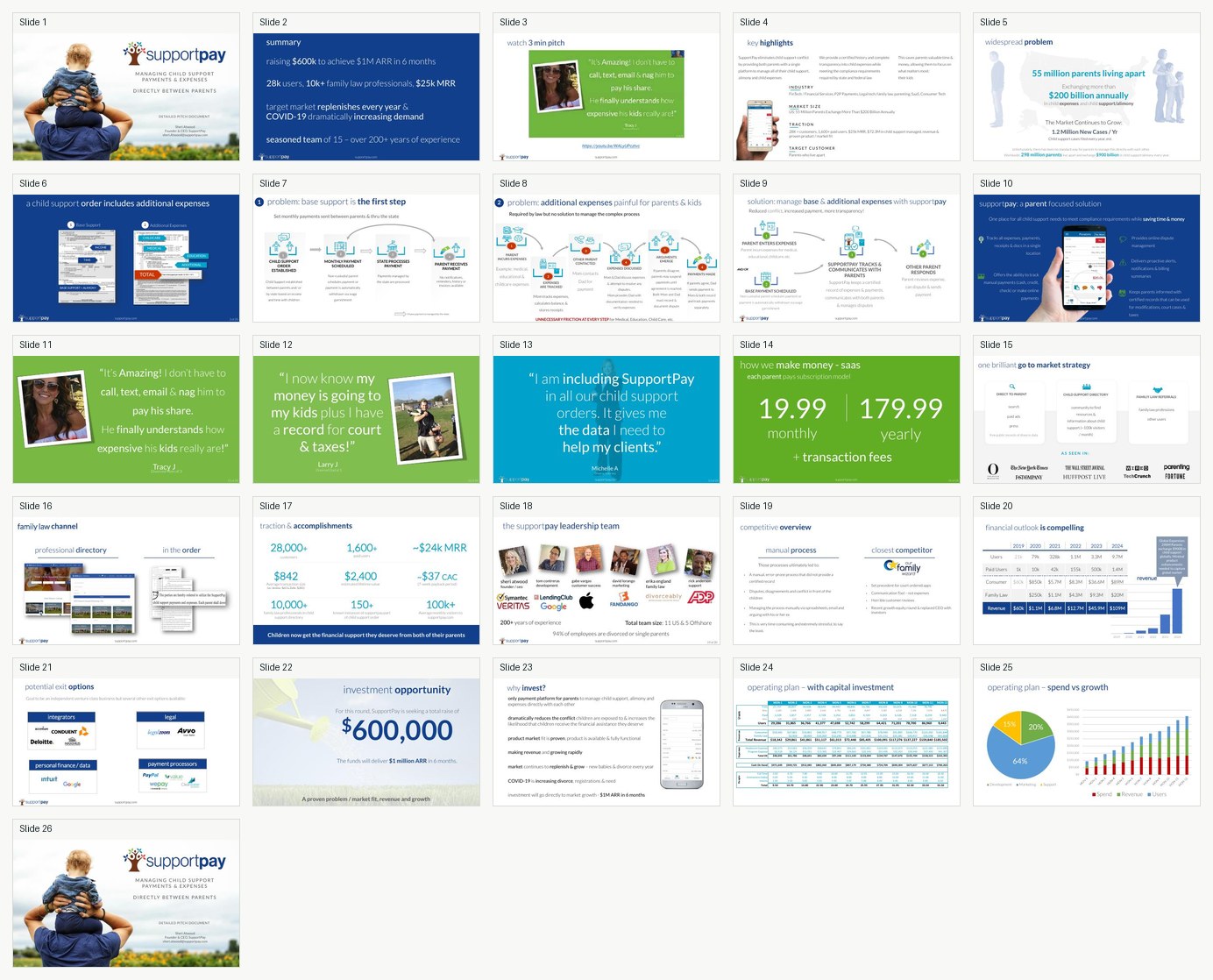
Embedded source PDF with local contact sheet. The deck is useful for workflow-heavy fintech, family-law distribution, SaaS operating plans, MRR/CAC/payback, and emotionally charged problem framing.
Active Company With Post-Deck Funding And A Broader Family-Finance Platform
SupportPay is still operating. The official site is active, app links are live, LinkedIn has current posts, and the company has expanded from child support management into family finance, caregiving, employee benefits, and enterprise financial wellness. The 2020 deck sought $600K; public sources show a later $3.1M Seed / strategic round in late 2023 or early 2024.
Operating Status
Official site, web app, app-store links, employer/enterprise sections, and current LinkedIn posts are live.
Headcount Trend
LinkedIn lists 11-50 employees and 10 discoverable employees. Historical Tracxn headcount is not current.
Funding Outcome
Public sources show $4.1M 2016 Series A and $3.1M post-deck Seed / strategic round.
SupportPay
A family-finance platform that started with child support and co-parent expenses, then expanded into shared family finances, caregiving, employer benefits, and enterprise financial wellness. Best used as a benchmark for painful workflow mapping, compliance records, SaaS metrics, and conservative forecast diligence.
Funding Evidence
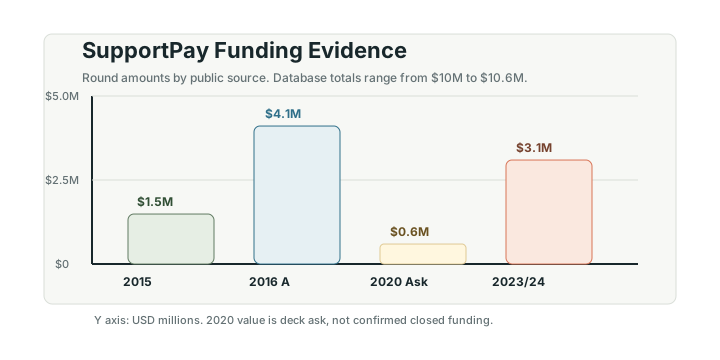
Chart shows public round amounts and the deck ask. Database totals range from about $10M to $10.6M; the 2020 $600K value is the deck ask, not confirmed closed funding.
SupportPay Is Strong For Workflow Pain And SaaS Discipline, Weaker As A Hypergrowth Forecast Model
The company is still active and raised capital after the deck. The most useful feedback pattern is how the deck explains a painful manual process, then supports it with MRR, CAC, payback, paid-user, average transaction, and operating-plan detail. The caution is forecast realism: public revenue estimates are far below the deck's most aggressive 2024 projection.
Use for family fintech and workflow mapping; challenge the growth forecast hard.
$3.1M Post-Deck Round
Founder Lodge, LinkedIn, and local press snippets support a 2023/2024 $3.1M round.
Still Active
Official site shows 500K+ lives impacted and $650M+ expenses managed.
Founder-Market Fit
Sheri Atwood's single-parent and enterprise-operator background maps directly to the problem.
Forecast Gap
Use deck projections as a diligence target, not as a proven outcome.
What The Deck Does Well
- Workflow clarity: Slides 7-10 show the manual support and expense process step by step.
- Metrics: Slide 17 includes MRR, paid users, CAC, payback, LTV, and average transaction size.
- Operating plan: Slide 24 connects raise amount, users, revenue, expense, headcount, and cash.
- Channel logic: Slides 15-16 show directory, family-law, referrals, search, ads, and court-order channels.
What To Challenge In Founder Decks
- Forecast realism: ask what must be true for a $600K raise to create $1M ARR in six months.
- Channel conversion: require conversion from directory visitors and family-law professionals.
- Compliance scope: define certified records, court acceptance, and state/federal constraints.
- Market math: separate total child support exchanged from serviceable paid SaaS demand.
Company Facts
Best Founder-Feedback Uses
Use Slides 7-10 to map every failure point in a painful manual process.
Use Slide 17 for MRR, CAC, payback, LTV, paid users, and transaction size.
Use Slide 24 to benchmark a month-by-month capital plan.
Use Slides 15-16 to test referral, legal, directory, and paid channels.
Funding Evidence
| Event | Date | Amount | Notes |
|---|---|---|---|
| Funding round | 2015 | $1.5M | T5 Capital Partners and high-net-worth individuals. |
| Series A | 2016 | $4.1M | Fenway Summer Ventures led; Moneta and Continental Advisors participated. |
| Deck ask | 2020 | $600K | Planned raise to reach $1M ARR in 6 months. |
| Seed / strategic | 2023/2024 | $3.1M | HearstLab plus 6 investors in LinkedIn/Crunchbase module. |
| Database total | 2026 check | $10M-$10.6M | Tracxn and ZoomInfo snippets conflict slightly. |
Most Useful SupportPay Slide Patterns
| Slide | Pattern | Feedback Prompt |
|---|---|---|
| 4 | Key highlights | Can you compress market, traction, and category into one diligence-ready summary? |
| 7-10 | Problem and solution workflow | What happens before, during, and after your product enters the workflow? |
| 14 | Pricing model | Who pays, how often, and why would both parties pay? |
| 17 | Traction dashboard | Are MRR, CAC, payback, LTV, and user definitions fully sourced? |
| 20 | Multi-year forecast | Which assumption is most fragile? |
| 24 | Operating plan | How does the raise change users, revenue, expenses, headcount, and cash? |
Deck Contact Sheet