TRILL Independent Streetwear Marketplace Deck
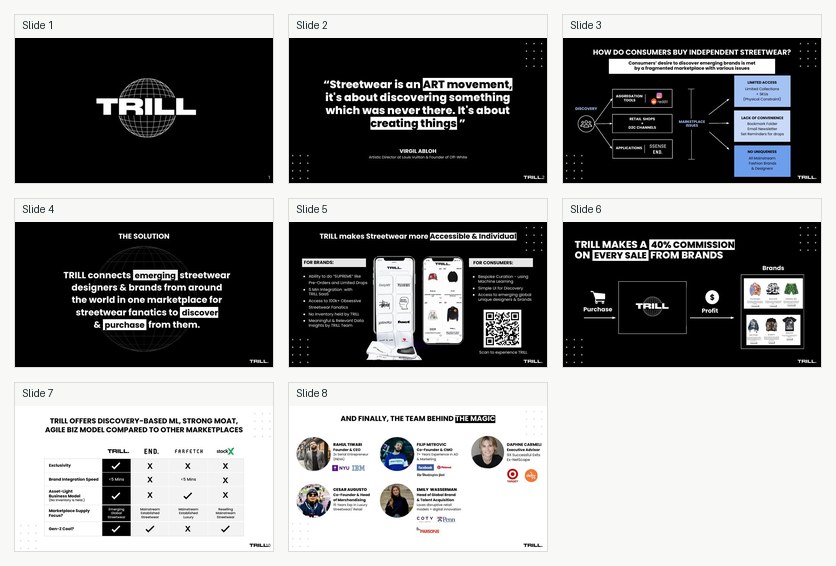
Embedded source PDF with local contact sheet. The deck is useful for marketplace problem framing, cultural wedges, two-sided value propositions, and the risks of under-explaining trust, fulfillment, and marketplace liquidity.
No Verified Active Marketplace Operation; Treat As A Cautionary Reference
TRILL had real public traction around 2020-2021, but current public evidence does not support an active marketplace status. LinkedIn and Wellfound profiles still exist, yet the historical marketplace domain no longer shows TRILL commerce, Wellfound lists 0 jobs, LinkedIn shows only 3 discoverable employees, and Trustpilot shows severe customer-trust issues.
Operating Status
Historical domain is no longer a streetwear marketplace. No verified active commerce operation found.
Headcount Trend
LinkedIn shows 3 discoverable employees; Wellfound and Prospeo list 1-10 employees and no jobs.
Funding Outcome
Public evidence supports a small 2020 pre-seed / XRC backing, but no later seed or Series A.
TRILL
A marketplace for independent streetwear designers that showed early cultural and marketplace promise, then became a cautionary example around trust, fulfillment, liquidity, and post-seed durability. Best used to teach founders what a marketplace deck must prove beyond a stylish problem and solution.
Funding Evidence
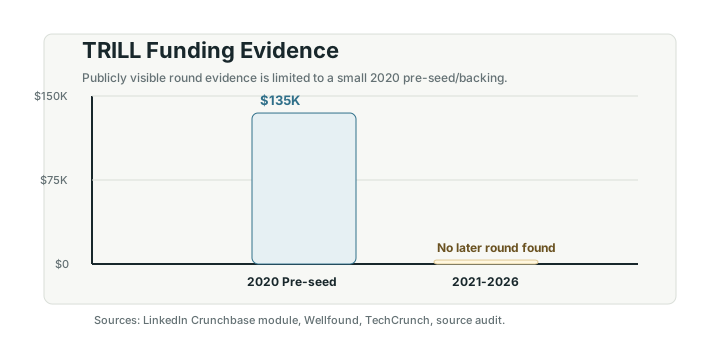
Chart shows the most visible public funding signal. Wellfound lists $100K total raised and a $4M valuation; LinkedIn/Crunchbase module and Prospeo show $135K.
TRILL Had A Real Wedge, But The Deck Under-Proved Marketplace Trust And Durability
The useful lesson is not that the idea was weak. TechCrunch and Glossy both reported meaningful early activity: 90+ brands, tens of thousands of MAUs, $100K+ GMV, $250K-$300K monthly sales, and a pooled manufacturing model. The weakness is that the deck did not make marketplace health, fulfillment reliability, refunds, authenticity, repeat purchase, or take-rate sustainability diligence-ready.
Use for marketplace feedback, not as a clean successful-fundraise benchmark.
90+ Brands
TechCrunch reported 90+ brands, tens of thousands of MAUs, and $100K+ GMV in May 2020.
Manufacturing Pooling
Glossy reported Trill helped small brands pool factory orders and carried around 80 brands.
Likely Inactive
The historical domain is not serving the marketplace and public hiring is absent.
Trust Breakdown
Trustpilot shows a 2.1 TrustScore across 161 reviews and severe fulfillment complaints.
What The Deck Does Well
- Culture: Slide 2 uses Virgil Abloh to frame streetwear as creative identity, not commodity apparel.
- Problem map: Slide 3 shows fragmented discovery and the awkward workflow of drops, newsletters, bookmarks, and retail channels.
- Two-sided value: Slide 5 names buyer curation and brand-side pre-orders, drops, SaaS integration, audience, and data.
- Competitive view: Slide 7 tries to differentiate from END, Farfetch, StockX, and mainstream marketplaces.
What To Challenge In Founder Decks
- Marketplace liquidity: require GMV, repeat purchase, active buyer, active seller, conversion, and cohort retention.
- Trust and fulfillment: show refunds, seller quality, dispute handling, delivery SLAs, and authenticity controls.
- Take rate: a 40% commission needs gross/net definition and proof that brands can afford it.
- ML claims: curation should show data advantage, not just a machine-learning label.
- Current status: this profile should not be recommended as a "successful later raise" comparable.
Independent streetwear discovery is fragmented and drop-driven.
TRILL wanted one destination for emerging designers and fans.
Glossy reported pooled factory orders for small designers.
Customer reviews point to fulfillment and refund failures.
The marketplace is not verified active in 2026.
Company Facts
Best Founder-Feedback Uses
Use Slide 3 when a marketplace founder needs to show fragmented discovery behavior.
Use Slide 5 to coach buyer and supplier value propositions on one slide.
Use Slide 6 to challenge gross vs net revenue and supplier willingness to pay.
Use the public outcome to explain why marketplace decks need operational proof.
Funding Evidence
| Event | Date | Amount | Notes |
|---|---|---|---|
| Pre-seed | 2020-02-15 | $135K | LinkedIn Crunchbase module lists XRC Ventures. |
| Wellfound total | 2020-03 | $100K | Wellfound lists $100K total raised and $4M valuation. |
| XRC Labs backing | 2020-05 | Undisclosed | TechCrunch says TRILL was backed by XRC Labs. |
| Later funding | 2021-2026 | Not found | No reliable public seed or Series A evidence found in this pass. |
Founder And Team Signal
| Person / Signal | Role | Research Note |
|---|---|---|
| Rahul Tiwari | Founder and CEO | Confirmed across deck, TechCrunch, LinkedIn, Wellfound, Tracxn, and Prospeo. |
| Filip Mitrovic | Co-founder / CMO | Deck and Wellfound support founder role and marketing responsibility. |
| Cesar Augusto L | Co-founder / merchandising / COO | Deck and Wellfound support supply and merchandising role. |
| Emily Wasserman | Global brand and talent acquisition | Deck-time role; not independently verified in this pass. |
| Daphne Carmeli | Executive advisor | Deck-time advisor signal; not independently verified in this pass. |
| Current public team | Tiny | LinkedIn shows 3 discoverable employees; Wellfound lists 1-10 and 0 jobs. |
Most Useful TRILL Slide Patterns
| Slide | Pattern | Feedback Prompt |
|---|---|---|
| 3 | Fragmented discovery problem | What does the buyer do today, and which step is most painful or costly? |
| 4 | One-line marketplace solution | Can you prove both sides want this marketplace at the same time? |
| 5 | Consumer and brand value props | Which side of the market is hardest to acquire and retain? |
| 6 | 40% commission | Is this gross take rate, net revenue, or margin after fulfillment/refunds? |
| 7 | Competitive map | Can each checkmark be backed by evidence, not assertion? |
| 8 | Fashion marketplace team | Which team members own supply, demand, product, trust, and operations? |
Deck Contact Sheet